
NAVIGATE MYTRAC™ — POWERED BY OPERATION JACK’S VILLAGE
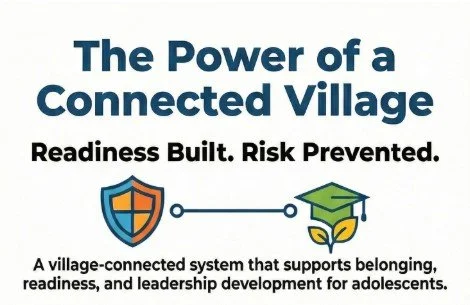
Readiness built. Risk prevented. Village connected.
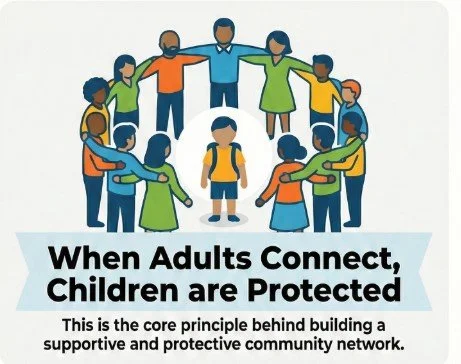
When adults are connected, children are protected.
Because Success Depends on iNDIVIDUAL CAPACITY & Engagement in the Right Environment.
Navigate MyTrac™ is the Village’s coordination system—designed to ensure every adolescent is surrounded by stable, predictable, connected adults who work together to support belonging, readiness, and leadership development.
See the Village Readiness Continuum
Explore the Navigate MyTrac™ Model
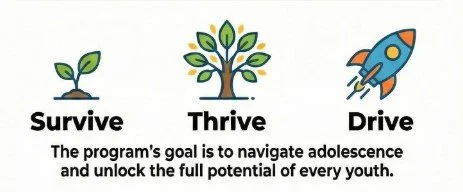
Survive: Assessment and Capacity
The Survive stage, where you assess where a teen is currently at, is vital because adolescents often send "quiet little signals" long before reaching a crisis. According to the sources, a primary red flag is sleep instability, which serves as a biological indicator that a teen’s system is overloaded. This assessment phase focuses on understanding a teen's individual capacity—essentially their "internal battery"—and how well their current environment aligns with that capacity. By identifying these patterns early, adults can make practical tweaks to routines and pacing to prevent "mood crashes" or school refusal.
Thrive: Discovery in Grades 7–9
During the Thrive stage (grades 7-8-9), students focus on "discovery" as their cognitive capacity expands rapidly. This is the developmental window where they begin asking core questions about identity and direction, such as "Who am I?" and "What am I capable of?". The sources suggest that for students to thrive, they need:
Structured opportunities to practice critical thinking and moral judgment.
An environment that emphasizes belonging and community contribution, which increases resilience.
A system that makes their readiness visible, showing exactly where they are succeeding and where they need environmental adjustments.
Drive: Agency and Coaching in Grades 10–12
In the Drive stage (grades 10-11-12), the focus shifts to coaching them through agency. The Navigate MyTRAC system is designed to build agency, ownership, and purpose by having students track their own goals, habits, and competencies. This coaching relationship is critical, as strong adult-student relationships are the single greatest protective factor during adolescence. This phase integrates academic learning with real-world application and vocational exploration, ensuring students aren't just following a schedule but are on a mission.
Launch: Health, Readiness, and Destination
The final stage, Launch, occurs when a student is safely prepared for their individual post-secondary destination. The sources emphasize that "Launch" is more than just graduation; it is the culmination of the student's development where they possess:
A documented record of competencies.
Practical skills for life and work, such as financial literacy and digital wisdom.
The maturity to navigate real-world environments and the determination to live a life of purpose that may "rise above the norm".
Ultimately, this progression ensures that students do not just drift into adulthood but are launched as capable, grounded young adults who are ready to contribute to their communities.
The extensive work of Operation Jack’s Village, a countermeasure to the digital, human deficits, impacting READINESS & RESILIENCE
THE CORE PURPOSE OF NAVIGATE MYTRAC™
-
MyTrac™ ensures that teachers, staff, families, mentors, and community partners all know:
who is connected to a child
what support is already in place
what routines or relationships need strengthening
what next steps adults — not children — are responsible for
It is the opposite of a “reporting system.” It is a coordination system.
-
This is the heart of the architecture.
Navigate MyTrac™ aligns with the Survive → Thrive → Drive continuum and:
tracks belonging indicators
monitors stability and predictability
supports earned agency growth
strengthens leadership development
ensures adult follow‑through
It tracks readiness and prevents risk by design. Not through alerts. Not through surveillance. But through the daily protective conditions adults build around children.
-
MyTrac™ maps the adults in a child’s world:
teachers
coaches
family members
neighbors
mentors
community partners
It ensures no child is ever “unknown” or unsupported.
-
When a child needs more connection, more structure, or more belonging, MyTrac™ helps adults:
identify the need early
coordinate who will respond
follow through with predictable support
close the loop
This is early support, not intervention.
-
Navigate MyTrac™ is the operational expression of the Zero Suicide principle that:
Systems — not individuals — must be reliable.
It ensures:
adults follow through
routines are consistent
communication is clear
accountability is shared
the Village stays connected
THE ARCHITECTURE OF NAVIGATE MYTRAC™
-
A simple, visual interface showing:
each child’s Village (the adults connected to them)
readiness indicators
belonging and stability markers
earned agency progress
leadership opportunities
This is not a “profile.” It is a Village map.
-
Where coach/teachers, staff, parents and partners can:
log adult actions (not student behaviors)
coordinate next steps
share observations about belonging or readiness
schedule check‑ins
track follow‑through
This is the heart of the system.
-
A rules‑based engine that helps adults determine:
what type of support is appropriate
who should take the lead
what timeline is needed
how to measure follow‑through
It is not diagnostic. It is operational.
-
Allows partnerships with:
city programs
youth organizations
local businesses
civic leaders
faith communities
This is how Oldsmar becomes a living classroom.
-
Aligned with Survive → Thrive → Drive:
Survive: routines, belonging, predictability
Thrive: collaboration, communication, earned agency
Drive: leadership, contribution, purpose
This is how MyTrac™ supports PBL and middle‑grade leadership.