
Rethinking School Safety
Two models.
Two philosophies.
Two VERY different ideas about what keeps children safe.
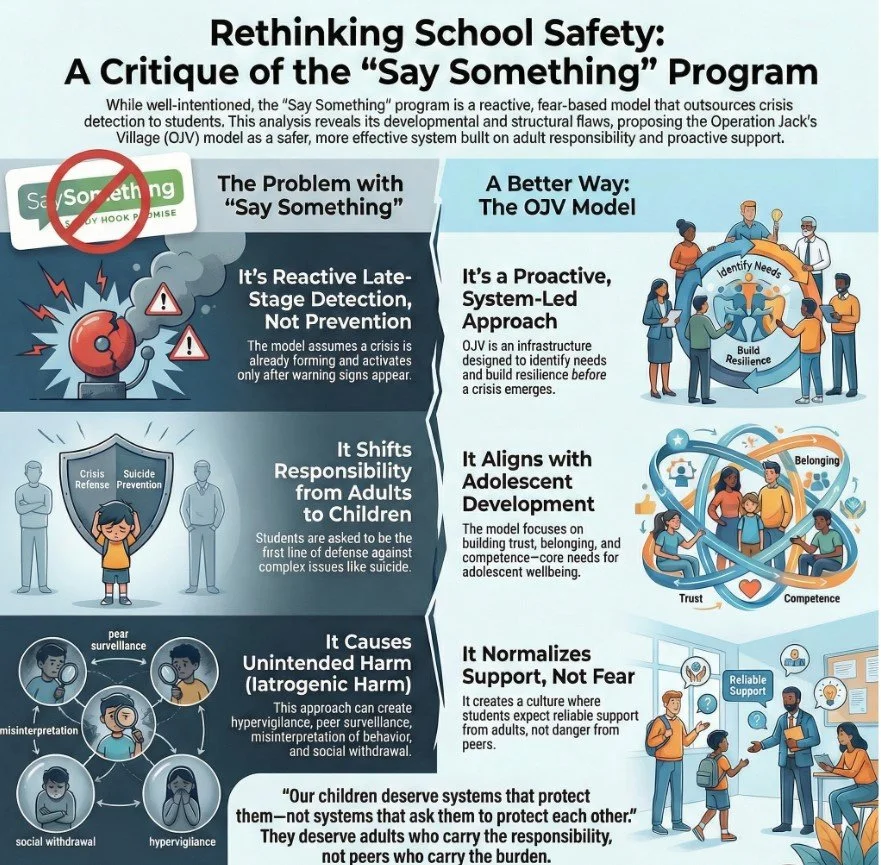
The Difference Between the Sandy Hook Promise Approach
and the OJV Promise Approach
Changing the conversation from policing to public health.
1. WHO CARRIES THE RESPONSIBILITY
Sandy Hook Promise (SS‑ARS)
Places responsibility on children to notice danger, interpret warning signs, and report their peers.
Children become the first line of defense.
Sandy Hook Promise
“See something, say something.”
A reactive detection model that activates after warning signs appear.
OJV Promise
Places responsibility on adults and systems to create safety, belonging, and early support.
Children carry none of the burden.
2. THE UNDERLYING LOGIC
OJV Promise
“Build the Village.”
A prevention‑first model that strengthens belonging, stability, and adult presence long before crisis forms.
3. DEVELOPMENTAL FIT
Sandy Hook Promise
Relies on adolescents to interpret complex emotional and behavioral cues—something they are not developmentally equipped to do.
OJV Promise
Aligns with developmental science: children need predictable adults, stable routines, and relational safety to thrive.
4. IMPACT ON STUDENTS
Sandy Hook Promise
Can unintentionally create iatrogenic harm, including:
hypervigilance
peer surveillance
shame and secrecy
false positives and false negatives
withdrawal from help‑seeking
Sandy Hook Promise
Measures tip volume and reporting activity.
OJV Promise
Creates protective factors, including:
belonging
trust
early adult support
earned agency
leadership development
community connection
5. WHAT THE SYSTEM MEASURES
OJV Promise
Measures population‑level wellbeing, belonging, readiness, and leadership growth.
6. HOW SAFETY IS CREATED
Sandy Hook Promise
Safety is created through alerts, hotlines, and crisis response.
OJV Promise
Safety is created through:
daily adult presence
predictable routines
community integration
early, non‑clinical support
earned agency practices
relational accountability
7. WHAT CHILDREN EXPERIENCE
Sandy Hook Promise
“We promise to teach children to report warning signs.”
OJV Promise
“We promise to build a Village where children are protected by adults, supported by community, and prepared to Survive, Thrive, and Drive.”

Supporting Safety through Human Connection, Not Apps
Because children are not supposed to be first responders
Supporting the Village Readiness Model and Explaining the Difference Between Sandy Hook Promise and the OJV Promise
Hello! My name is Liz, and I’m here on behalf of the children of Oldsmar and the families who believe that our schools must be places where every child belongs, every child is known, and every child is supported long before crisis forms.
Today, I want to speak clearly about the difference between two very different approaches to school safety: the Sandy Hook Promise approach and the OJV Promise approach.
This distinction matters, because the model we choose determines whether our children carry the weight—or whether we, the adults, do.
Sandy Hook Promise is a detection tool that depends on children. The OJV Promise is a prevention system that depends on adults and community.
That single difference changes everything.
The Sandy Hook Promise model asks children to watch each other, interpret warning signs, and report their peers. It turns adolescents into the first line of defense, even though we know from developmental science that they are still learning how to read their own emotions, let alone someone else’s.
The OJV Promise asks adults to show up for every child, every day, with predictable care, early support, and a commitment to belonging. It places responsibility where it belongs—on the systems and adults who promised to protect them.
One approach reacts to danger after it appears. The other builds the conditions where danger struggles to grow.
One creates fear, hypervigilance, peer surveillance and iatrogenic harm. The other creates belonging, trust, relational safety and protects mental health. (the root of all physical safety risks in schools)
One is a program. The other is a Village.
The Sandy Hook Promise model was created as a reaction to a tragic event. The OJV Promise was created as a proactive response to a tragic event, but as a root‑cause corrective‑action model, designed to be 99.99966% effective, grounded in decades of neuroscience, adolescent brain development, and the lived experiences of students, teachers, and families. It was shaped with input from experts in adolescent development and community safety, and it reflects what children themselves say they need.
The OJV Promise is not about catching danger. It is about preventing it by strengthening the village around every child.
The Village Readiness Model gives schools a structured, developmentally aligned framework that builds belonging, predictability, earned agency, and adult responsibility into the daily life of a school. It prepares students to Survive, Thrive, and Drive—not through fear, but through connection.
OJV is proposing the Oldsmar K–8 lead Florida as the first Village Readiness Demonstration School. Our children deserve a model that honors their development, protects their dignity, and strengthens the adults and systems around them.
We can choose a model that burdens children with responsibility they are not developmentally equipped to carry. Or we can choose a model that builds a Village around them.
I’m asking you to choose the Village. Choose prevention over detection. Choose belonging over fear. Choose adult responsibility over student burden. Choose the Village Readiness Model for Oldsmar—and for every child who deserves the adults in their life and schools that keeps its promises.
Thank you.
Jack’ Mom